
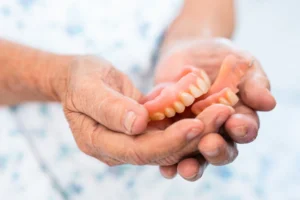
 Replacing a full arch of missing teeth is one of the bigger decisions you’ll make for your long-term health, and the options can feel overwhelming. Traditional dentures have been around for generations, and implant-supported dentures are becoming more widely available. Each approach carries its own set of trade-offs in comfort, bone health, cost, and daily function. Understanding those differences before you sit down with a provider can make the conversation a lot more productive.
At Spring St. Dental in Bastrop, TX, we work with patients across the area who are weighing exactly this choice. Our team, which includes Dr. Matthew Lassen, Dr. Meghan Bhakta, and Dr. Brian Romney, evaluates each patient’s bone structure, health history, and long-term goals before recommending a path forward. We use in-house 3D cone beam CT (CBCT) imaging, not standard two-dimensional X-rays, to get a complete picture of your jaw anatomy before any treatment planning begins.
How the Two Options Actually Work
The foundation of each approach is what sets them apart most.
Traditional Dentures
Traditional dentures rest on top of your gum tissue and rely on suction, adhesives, or the natural contours of your jaw for stability. They are removable, typically fabricated as a complete set for the upper or lower arch, and do not require surgery. Complete and partial dentures remain a reliable option for patients who cannot undergo implant surgery due to health conditions or bone volume limitations.
Because no implants are placed, the underlying jawbone receives no stimulation from chewing forces. Over time, that lack of stimulation leads to resorption, meaning the bone gradually shrinks in both height and width. A 2020 systematic review and meta-analysis published in the International Journal of Prosthodontics found that four-implant-supported overdentures produce significantly less bone loss in the posterior mandible than conventional complete dentures, though two-implant versions did not show the same advantage in that specific region.
Implant-Supported Dentures
Implant-supported dentures anchor to titanium posts that are surgically placed in the jawbone. Once the implants fuse with the surrounding bone through osseointegration, the restoration snaps or screws onto the posts, providing a level of stability that traditional dentures cannot match. We offer implant-supported dentures as part of our full-arch treatment options, and all surgical work is performed in-house.
Day-to-Day Differences You Should Know
Living with either option affects more than just how your teeth look. It shapes how you eat, speak, and feel about your smile.
With traditional dentures, patients often report movement during chewing or speaking, particularly in the lower arch. Adhesives can help, but require daily application and do not fully replicate the grip of a fixed or secured prosthetic. Over time, as the jawbone changes shape, dentures need relining or replacement to maintain a proper fit.
Implant-supported dentures behave more like natural teeth in daily function. The attachment to your jawbone means there is no slipping, and you do not need adhesive. Most patients report being able to eat a broader range of foods and speak with more confidence. Cleaning routines are more straightforward as well since the restoration either removes for cleaning or is maintained with standard brushing and flossing, depending on the design. Our dental implants page covers the implant process in detail if you want to understand what placement looks like from start to finish.
What the Process Looks Like at Each Stage
Before any recommendation is made, we take a thorough look at your bone density and jaw structure using our in-house CBCT scanner. This step is critical because implant placement requires adequate bone volume, and patients who have worn traditional dentures for years may have experienced resorption that affects candidacy. For some patients, bone grafting may be needed before implants can be placed.
Traditional dentures can often be completed in fewer appointments. After extractions heal, impressions are taken, and the dentures are fabricated and adjusted. The timeline is shorter and the upfront cost is lower. That accessibility makes them a legitimate starting point for many patients, particularly those managing tight budgets or medical conditions that complicate surgery.
Implant-supported dentures involve a surgical phase, a healing period, and then final restoration placement. The timeline is longer, but the investment reflects a prosthetic that functions at a higher level and protects the jawbone. In some cases, we can place implants and load a temporary restoration on the same day, reducing time without teeth. The financing options we offer are worth reviewing if cost is a factor in your planning.
Schedule a Consultation at Spring St. Dental
At Spring St. Dental, we give every patient a clear-eyed comparison of their options, backed by 3D imaging and a team that performs the full scope of implant and restorative care in one location. Dr. Lassen, Dr. Bhakta, and Dr. Romney each bring distinct clinical strengths to complex cases, and having all three providers under one roof means you are not piecing together treatment from multiple offices.
If you are exploring denture options in Bastrop or the surrounding communities, we would be glad to sit down with you and go through what each path realistically involves for your situation. Contact our office to schedule your consultation and get a complete picture of your options.