
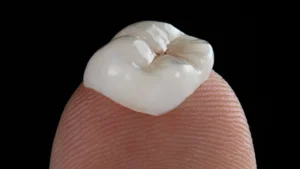
 When a tooth has too much damage for a standard filling but not enough to warrant a full crown, it can feel like you’re stuck in a gray area with no clear path forward. That in-between space is exactly where treatment choices get complicated, and where understanding your options becomes worth the effort. Some restorations hold up over time, others wear down faster than expected, and the difference often comes down to how and where the material is made.
At Spring St. Dental, we offer porcelain and composite inlays as a precise, durable approach for teeth that fall into that middle ground. Unlike traditional practices that require a second appointment and a temporary restoration, we can complete inlays in a single visit, which means fewer disruptions to your schedule and a final result placed the same day you walk in.
What Makes an Inlay Different From a Filling
A conventional filling is placed directly into the tooth, shaped, and hardened in the chair. It works well for smaller areas of decay, but as the cavity size grows, a direct filling can struggle to maintain its contour, hold up under the pressure of chewing, and seal tightly at the edges. An inlay is fabricated outside the mouth as a precisely fitted restoration and then bonded into place, allowing for much tighter margins and a more accurate fit to the tooth’s natural shape.
The Case for Indirect Fabrication
Because inlays are made from a detailed impression or digital scan of your tooth, they fit the prepared space with a level of accuracy that a chairside filling can’t quite match. Research published in the European Journal of Dentistry found that composite resin inlays and onlays placed in 32 patients showed 100% clinical success at the 6-year mark, with strong scores for marginal integrity, surface texture, and patient acceptance evaluated over 9 years. That kind of documented performance reflects what an indirect approach, done well, can deliver.
The material itself also benefits from the fabrication process. When composite or porcelain is cured in a controlled lab or milling environment rather than directly in the mouth, it can achieve a more consistent hardness and wear resistance.
Where Fillings Still Make Sense
Traditional fillings remain a reliable and appropriate choice for smaller areas of decay. If the cavity is contained, the tooth structure around it is strong, and the bite load in that area is manageable, a direct filling gets the job done without additional steps. We use both approaches at Spring St. Dental, matching the restoration to what the tooth actually needs rather than defaulting to one option.
How the Single-Visit Process Works
Traditional inlays typically involve two appointments: one to prepare the tooth and take an impression, and a second to seat the final restoration after a lab fabricates it. During that waiting period, patients wear a temporary covering that can sometimes feel uncomfortable or come loose before the permanent piece is ready.
What We Do Differently
We use CEREC same-day crown technology along with digital impressions and in-house milling to complete inlays in one appointment. The tooth is prepared, scanned digitally, and the restoration is designed and milled on-site. By the time you leave, the inlay is bonded in place, and you’re done. There’s no temporary, no second visit, and no waiting on a lab turnaround.
Our 3D cone beam CT imaging and digital scanning tools let us capture the preparation with a level of detail that supports a precise fit from the first seating. You can read more about how our same-day crown appointments work to understand what this process looks like in practice.
Material Options: Porcelain vs. Composite Inlays
Both porcelain and composite inlays are offered at our practice, and each has its place depending on where the tooth is located, how much chewing force it handles, and what result you’re looking for aesthetically.
Porcelain inlays are known for their color match to natural enamel, their rigidity, and their durability under heavy bite loads. Composite inlays are somewhat more flexible, which can be easier on opposing teeth, and they allow for quicker adjustments when needed. Here’s a quick look at what each option tends to offer:
- Porcelain inlays: high durability, excellent enamel-like color match, resistant to staining
- Composite inlays: more tooth-like flex, easier to adjust, good aesthetics in most light conditions
- Both options: custom-fabricated fit, bonded for structural strength, completed in one visit at our practice
The choice between the two is something we walk through with you based on the specific tooth, your bite, and your preferences.
Schedule Your Inlay Consultation at Spring St. Dental
At Spring St. Dental, we pair modern technology like CEREC, digital impressions, and in-house milling with a team that takes the time to explain what each restoration can and can’t do. Dr. Matthew Lassen, Dr. Meghan Bhakta, and Dr. Brian Romney each bring focused training to restorative care, and completing inlays in one visit is a capability we’ve built into the way we work for every patient who needs it.
If you’ve been told you need more than a filling but aren’t sure what that means for you, we’re glad to walk through your options and help you decide with confidence. Contact us through our online form to schedule a consultation at our Bastrop, TX office.